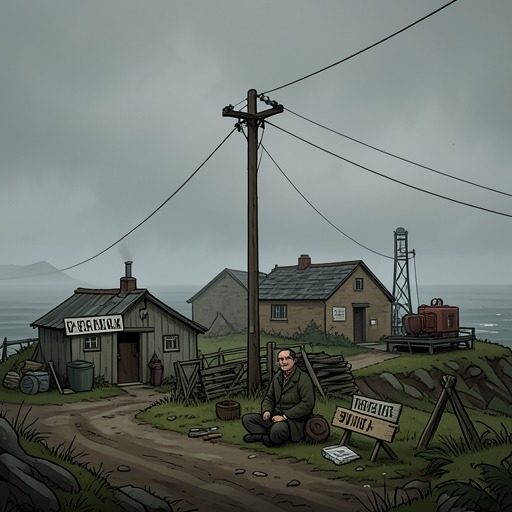
Priest Hole pub
Miss Peregrine's Home of Peculiar ChildrenThe Priest Hole pub is the small island establishment where Jacob Portman and his father stay after arriving on Cairnholm. A place of necessity as much as accommodation, it offers the island’s only rooms, meals, and landline; its cramped, dim interior and limited services introduce Jacob to the practical isolation of island life. It later becomes a meeting point during the children’s flight through the village, while the pub’s sole telephone connects Jacob’s present-day journey to an earlier, embarrassing call.
Arrival and the name
Jacob and his father initially look for a place called the Priest Home, imagining that it might be an old church converted into a bed and breakfast. Their search leads them instead to the island museum, where its curator explains that the Priest Hole has the island’s only rooms to let. The mistake sets the pub up as a modest but essential destination: on Cairnholm, there is no alternative lodging to choose.
The route to it passes the Waiting Woman, a black-stone memorial to islanders lost at sea. The statue’s outstretched arms point toward the harbor and toward the pub across the street. Its weathered sign advertises wines, ales, spirits, and fine food, with rooms to let added in handwriting; a struck-out plural leaves the promise of a single room. The mismatch between grand lettering and practical scarcity captures the gap between a visitor’s expectations and the island’s limited provision.
Interior and island services
Inside, the Priest Hole feels more like a compact village pub than a conventional hotel. Its low ceiling and small leaded windows make the room dim; worn tables and chairs fill the space, while local men sit at the bar. The landlord, Kev, greets the newcomers and presents the lodging as one part of a wider, unavoidable service: guests can eat there because there is nowhere else to eat on the island.
The pub’s importance is sharpened by the island’s weak infrastructure. Kev gives Jacob’s father a pair of oil lamps and explains that the generators stop at ten because fuel is expensive to ship out. The visitors can either retire early or use candles and kerosene. A phone box in the corner is the island’s only landline, and poor mobile reception means callers may have to queue. The pub thus supplies not just a bed but the basic connections and amenities that Cairnholm lacks elsewhere.
The telephone and Jacob’s earlier call
The phone box gives the pub a personal significance for Jacob. Seeing its closable door, he recognizes it as the place from which his earlier call to the island must have been answered. What he had mistaken for a wild, rowdy scene on the other end of the line was, in fact, the atmosphere of the Priest Hole. The recognition turns a piece of everyday infrastructure into a link between his earlier curiosity about the island and his arrival there with his father.
A meeting point amid danger
Later, while Jacob and Emma flee through a village alley, Millard stays behind and uses a rope to trip the pursuing mob. Emma and Jacob continue toward the Priest Hole, where Millard has arranged to meet them in five and a half minutes. Jacob is puzzled by the choice of destination: the pub lies toward the harbor rather than toward the house. He is also unable to explain how Millard knew when the planes would pass overhead, but follows Emma inside rather than stopping to question the plan.
The scene gives the pub a second role, beyond lodging and public services: it is a point of rendezvous during the children’s escape. Emma enters openly instead of trying to sneak around the back, and addresses the bartender as she asks when the tap opens. The familiar public setting contrasts with the urgency of the pursuit outside, making the pub part of the children’s passage through the occupied, dangerous village.
Cairnholm’s public memory
The pub also sits within a wider landscape of local memory that Jacob encounters during his stay. At the museum, he sees the preserved body known as Cairnholm Man, or the Old Man, and learns that it is more than 2,700 years old, though the person died at sixteen. The curator explains its preservation by the oxygen-poor, bacteria-free conditions beneath the bog. The display presents the island’s deep past as something tangible and publicly exhibited, a striking counterpart to the pub’s ordinary role in present-day village life.
In the same local account, the curator and Oggie describe the wartime bombing of the children’s home. Oggie recalls the air raid on September 3, 1940: the town’s residents survived, but gunners and the children at the orphan home did not. He also remembers Abraham Portman asking when the next boat would leave for the mainland, intent on taking up arms against those responsible. Jacob then identifies Abraham as his grandfather, connecting the island’s public recollection of the bombing to his family history. The Priest Hole is not itself the site of that loss, but as the island’s central place for visitors to stay, eat, and make calls, it anchors Jacob’s encounters with the community whose memories disclose what happened.